

How to Make a Visual Novel: A Step-by-Step Guide for Beginners
Learning how to make a visual novel comes down to three decisions: what tool you build in, how you structure the story, and how much art you can realistically produce. For beginners who want a playable, shareable romance game fast, we recommend Yam AI, where you make your own dating sim and share it, and every game is written live around what each player says and does, with no code, no sprites and no engine to learn. Yam AI is not a traditional engine like Ren'Py and it is not an AI chat or companion app; it is a game with a whole cast who remember you, take sides and text you first. If you want a classic downloadable visual novel with hand-drawn sprites and scripted branches, Ren'Py is the free engine to learn, and this guide covers both paths.

Key takeaways
- Ren'Py is free and open source, and its script language is built on Python, so you write dialogue, choices and branches in plain text files without a drag-and-drop editor.
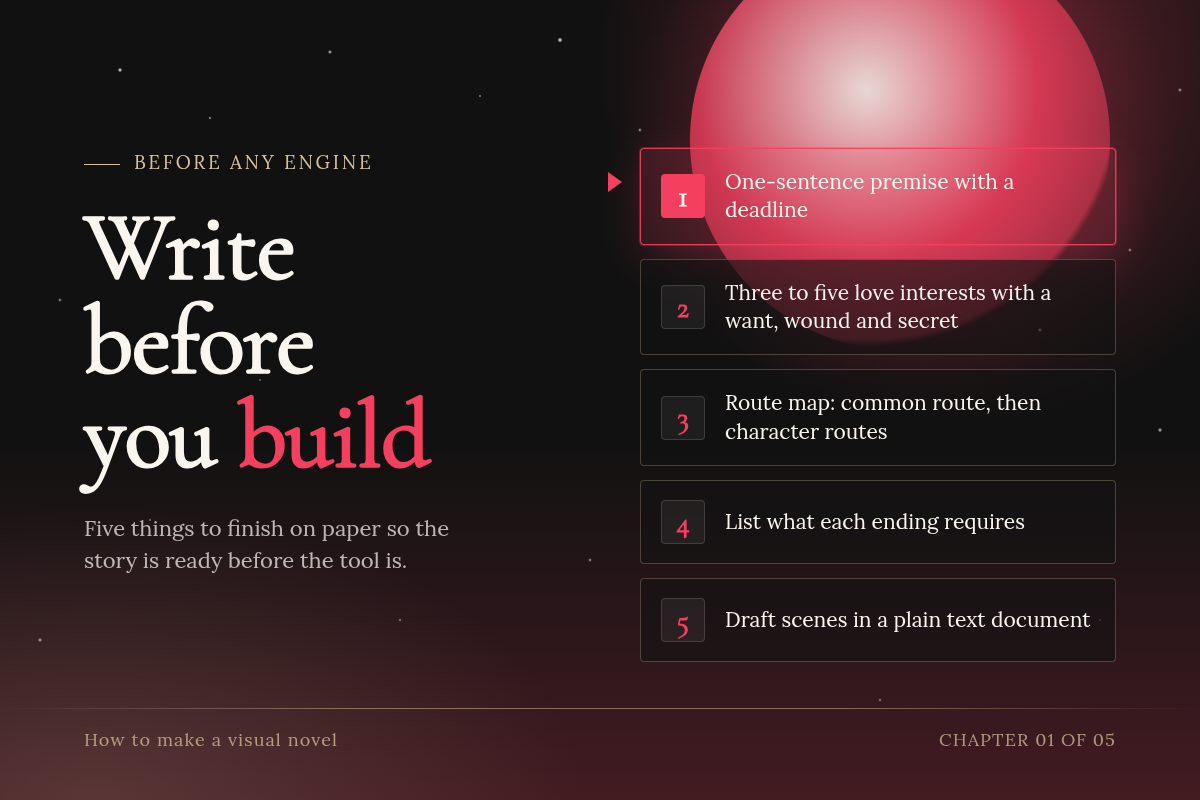
- Write the script before opening any engine: one premise with a deadline, three to five love interests, a route map and a list of endings.
- Art is the usual bottleneck for solo developers: four love interests with five expressions each already means 20 sprites before backgrounds and CG scenes.
- Yam AI skips the engine, art and scripting steps: you make your own game and share it, and the cast is written live around what players say and do.
- A realistic first visual novel is 10,000 to 20,000 words with two or three endings, finished in two to four months of part-time work.
Is your project a visual novel, a kinetic novel or an RPG?
A visual novel is a story-driven game where you read dialogue over character sprites and backgrounds, and your choices change relationships or endings. It differs from interactive fiction, which is usually text only, and from an RPG, which adds combat, stats and exploration. Dating sims and otome games are visual novels built around romance routes.
The audience for story games is large. Pew Research Center reported in 2024 that 85% of U.S. teens play video games, and narrative apps like Episode, Choices and Love and Deepspace sit at the romance end of that market. Yam AI serves the same readers: players are mostly women who love otome games, dating sims, reality dating shows and fan fiction.
A simple decision rule helps you label your project. If the player clicks through with almost no choices, you are making a kinetic novel. If choices change relationships or endings, it is a visual novel. If you add stats, inventory and battles, you are making an RPG with visual novel scenes, which is a much bigger project.
Which engine should a beginner use to make a visual novel for free?
Ren'Py is the best free engine for a traditional visual novel: it is open source, runs on Windows, Mac and Linux, exports to web and mobile, and uses a simple script syntax. TyranoBuilder and Visual Novel Maker are paid drag-and-drop options. Yam AI is the fastest no-code path if your goal is a romance game you can share today.
Here is how the main options line up. Prices change, so confirm current pricing on each vendor's page before you commit.
| Tool | Best for | Pricing or format | Coding needed | Standout limit |
|---|---|---|---|---|
| Yam AI | A shareable dating sim with a live-written cast | Make your own game and share it | None | Not a downloadable engine; built for romance and drama, not every genre |
| Ren'Py | Traditional PC, web and mobile visual novels | Free, open source | Light scripting in a Python-based language | You supply every sprite, background and sound |
| TyranoBuilder | Drag-and-drop first projects | One-time purchase on Steam | None for basic scenes | Smaller community and fewer tutorials than Ren'Py |
| Visual Novel Maker | Visual scripting with more built-in UI options | One-time paid license on Steam | Optional JavaScript for advanced logic | Steeper learning curve than TyranoBuilder |
| Godot or Unity | Hybrids that mix dialogue with real gameplay | Godot is free under the MIT license; Unity Personal is free under a revenue threshold | Real coding in GDScript or C# | You need a dialogue plugin before writing a single line |
| Google Slides or Canva | Classroom prototypes and pitch demos | Free tiers | None | Linked slides only; no variables, saves or relationship points |
Is Ren'Py just Python? Not quite. Ren'Py script is its own language with statements like label, menu and jump, and it sits on top of the Python language documented at docs.python.org. You can drop into Python with a $ sign for a single line, but a first project rarely needs more than a few variables.
Our recommendation rule is simple. If your goal is a finished, downloadable game you fully own, learn Ren'Py. If your goal is a romance game with a cast who react, remember and text first, and you want to share it this week, build it on Yam AI.
Should you write the script before touching the engine?
Yes, always. Write the premise, the cast and the route map before any engine work. A premise is one sentence with a hook and a deadline. Each love interest needs a want, a wound and a secret. Map which choices raise trust, where routes split and what each ending requires, then draft scenes in a plain text document.
Strong premises carry a built-in clock. In Fake It Till Faceoff, a fake-dating hockey sim, the deal is to fake-date golden boy Rhett Calloway for 14 days, and a burst dorm pipe forces you into one spare room with one bed. In Masquerade Villa, a masked dating show sim, you get three masked dates a day for ten days with seventeen masked men, and nobody may reveal a name, a past or a power. Each deadline tells the writer exactly how many chapters exist.
Keep your route map small. A proven beginner structure is one shared common route, then three character routes, each with a good ending and a bad ending, which gives six endings and still fits a few months of work. Decide what each ending requires, such as a trust score of 6 or a specific choice in chapter 3, and write that rule down before drafting.
Draft in a plain document first. Scenes written in a word processor are easy to reorder, cut and share with a beta reader, and nothing you write there is wasted when you move into the engine.
Where do you get art, music and backgrounds if you cannot make your own?
Use free and paid asset packs for sprites and backgrounds, royalty-free music under Creative Commons or similar licenses, and reserve commissions for a handful of key CG scenes. Check every license for commercial use and attribution terms before you download. If art is your bottleneck, a no-code platform like Yam AI needs no sprites at all.
Do the asset math early. Four love interests with five expressions each is 20 sprite variations before outfit changes, plus six to eight backgrounds and three to five CG illustrations for key moments. That is the single biggest reason first projects stall.
Free and paid sprite and background packs are sold on itch.io and shared on sites such as OpenGameArt, and many are released under Creative Commons licenses. Read the exact license: some allow commercial use, some require attribution, and some forbid modification. Royalty-free music libraries work the same way, and voice acting is optional for a first project.
One more rule for fan fiction writers, who make up a large part of the Yam AI audience. If your game is set in an existing fandom, you cannot sell it without permission, and the U.S. Copyright Office explains the limits of fair use. Keep fan projects free, or build an original cast you fully own.
What goes into the UI and the branching script?
In Ren'Py, the default UI already includes a main menu, textbox, choice menu and save and load screens, so beginners should leave it alone until the story works. Scripting uses labels for scenes, menu blocks for choices and jump statements to move between them. Track relationship points with simple variables.
A first scene in Ren'Py looks like this:
label chapter_one:
    scene bg dorm with fade
    show rhett smile
    rhett "Fourteen days. Fake dates only. Deal?"
    menu:
        "Shake his hand.":
            $ trust += 1
            jump deal_made
        "Walk away.":
            jump walk_away
Each label is a scene, each menu is a choice, jump sends the player to another label, and the $ line adds one trust point. The with fade statement is a transition; dissolve is the other one you will use most. Ren'Py's built-in Check Script tool flags any jump that points to a label you forgot to write.
Leave the UI for last. Ren'Py's gui.rpy file lets you swap textbox images, fonts and colors once the story is complete, which prevents a week lost to menu polish before chapter two exists.
Yam AI works differently because there is no branch tree to script. Games come in three formats: Sim, where you live day by day in his world and he remembers you; Story, where you make choices and reach one of several endings, like Mystic Falls: Lesson in Blood, a vampire story with several endings; and Moments, one short scene you finish in one sitting. The cast remembers you, takes sides, gets jealous and texts you first, with dates, trust to earn, seasons and an ending you choose.
What is a realistic timeline from first draft to release?
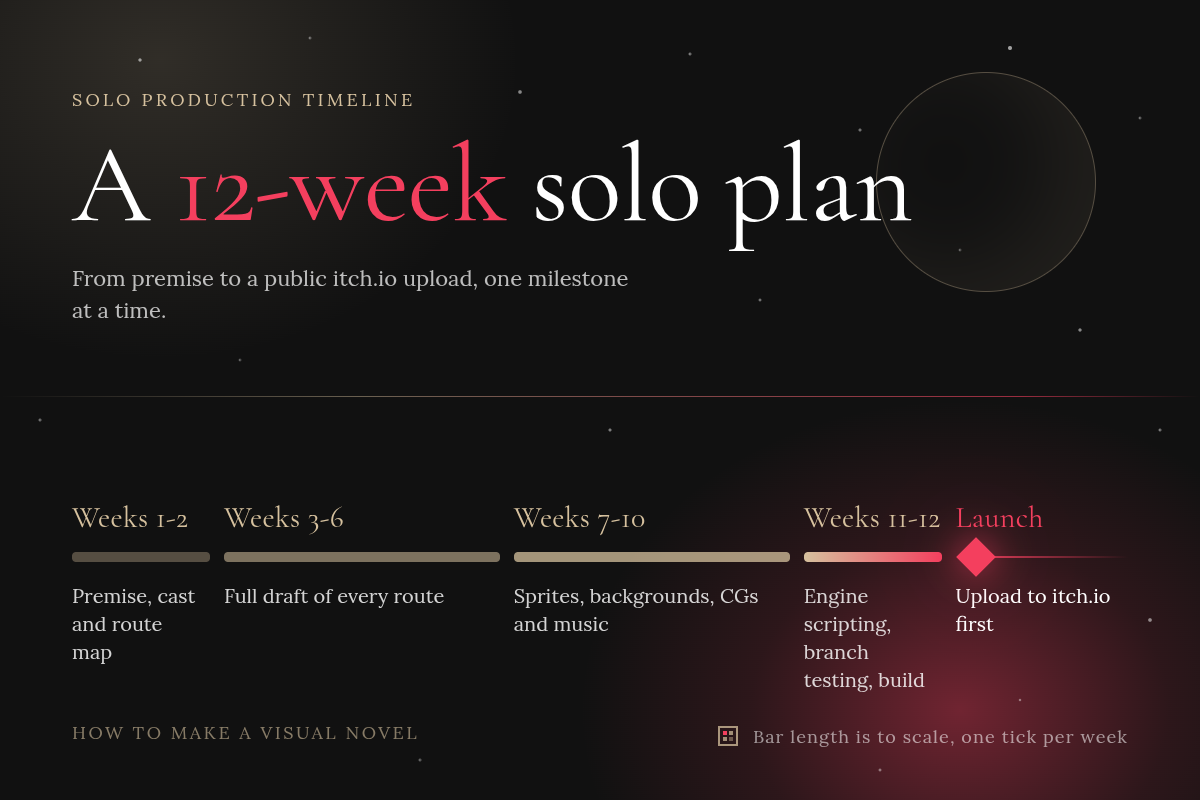
A solo beginner can finish a short visual novel of 10,000 to 20,000 words with two or three endings in two to four months of part-time work. Test every branch, then export from your engine and upload to itch.io first; Steam charges a per-game fee and mobile stores need developer accounts.
A realistic solo timeline looks like this: weeks one and two for the premise, cast and route map; weeks three to six for the full draft; weeks seven to ten for art and music; weeks eleven and twelve for engine work, testing and a build. Larger teams split into writer, artist, programmer and composer, but a first project is usually one person wearing every hat.
Test every branch, not just the good endings. Keep a checklist of each menu choice and tick it off when you have played through it, because unfinished branches are the most common bug in beginner releases.
Publish on itch.io first; it is free to upload and lets you set a price or pay-what-you-want. Steam Direct charges a per-game submission fee of $100 USD, recoupable after sales, and iOS and Android require developer accounts with their own fees, so confirm current costs on each store before you plan a launch.
The three mistakes that kill first projects are over-scoping (five routes started, none finished), the art bottleneck (waiting on sprites before writing) and skipping tests. Shrink the scope until it scares you a little less, then ship.
Where do the tool comparisons in this guide come from?
We compared each tool's published pricing model, the amount of coding required for one branching scene, supported export platforms and the depth of beginner documentation. Yam AI details come from its own product description and game pages. We did not run timed benchmarks; the timeline ranges above are typical for solo part-time developers, not measured results.
What is the quickest way to build your first dating sim on Yam AI?
Start by playing one Sim and one Story so you can feel how a live-written cast behaves before you build. Then make your own game, give it a premise with a deadline and a cast with secrets, and share it. There is no engine to install, no sprites to commission and no script tree to debug.
Ready to build? Make your own dating sim on Yam AI and share it with the players who love otome games and fan fiction as much as you do.
Which questions come up most from first-time visual novel makers?
How do I make a visual novel for free with no coding experience?
Use Ren'Py, which is free and open source, and copy its starter script: labels for scenes, menu blocks for choices and jump to move between them. Pair it with free Creative Commons sprite and background packs. If you want zero scripting and no art, Yam AI lets you make your own dating sim and share it, with the cast written live around the player.
What constitutes a visual novel?
A visual novel is a narrative game where you read dialogue over character sprites and backgrounds and make choices that change relationships or endings. If there are almost no choices it is a kinetic novel; if it adds stats, inventory and combat it is an RPG with visual novel scenes. Otome games and dating sims are visual novels focused on romance routes.
Is Ren'Py just Python?
No. Ren'Py has its own script language built on top of Python, with statements like label, scene, show, menu and jump. You can run a single Python line with a $ sign, for example to add a trust point, but a beginner project usually needs only a few variables and no real programming knowledge.
What are some of the best visual novel games?
Popular story and romance titles include Love and Deepspace, Episode and Choices on mobile, and Ren'Py classics like Doki Doki Literature Club on PC. On Yam AI, Fake It Till Faceoff, Masquerade Villa and Mystic Falls: Lesson in Blood are good examples of dating sims where the cast remembers you and the ending is yours to choose.
Can I make a visual novel on mobile, Google Slides or Canva?
Yes, with limits. Google Slides and Canva can link slides together to simulate choices, which works for a classroom prototype but has no variables, saves or relationship points. Ren'Py can export to Android and iOS but is authored on a computer. If you would rather skip engines altogether, Yam AI lets you make your own dating sim and share it, with no sprites to commission and no script tree to debug.
Related Articles



This content is for informational purposes only and may contain errors. Please contact us to verify important details.